10 or 15 US gallons: what should I compare?
Start with crop plan, available floor space, media budget and irrigation frequency. Compare a filled sample in the intended layout instead of assuming a larger label delivers a better yield.
 GROWING CONTAINERS
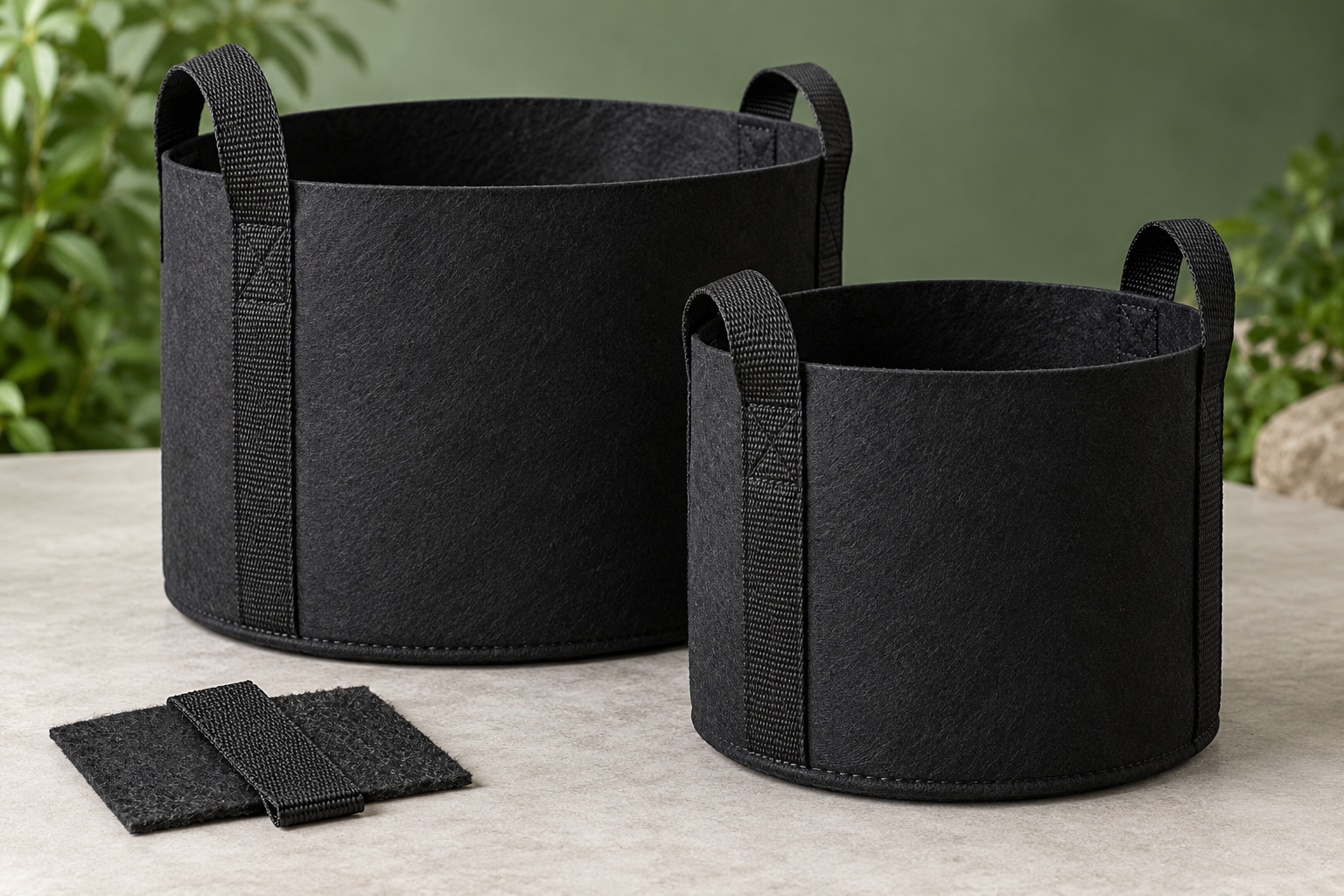
AI-generated concept. Bag sizes, material, fabric weight and handle construction are not confirmed supply specifications.
GROWING CONTAINERS
Choose the capacity. Verify the handling.
A proposed upgrade program for garden importers, nursery buyers and growing-supply distributors. Discuss 10- and 15-US-gallon options alongside your existing range, with actual volume and wet-load handle performance defined before bulk approval.
CAPACITY & SAMPLE REVIEW
Proposed configurations require supplier confirmation. No price, MOQ, performance rating or lead time is promised here.
No outcome is guaranteed by the capacity label alone. Compare actual volume, footprint, irrigation management and handling needs. This grow-bag project focuses on a proposed larger-capacity, reinforced-handle program; the existing standard 5-gallon product has its own page.
Looking for the existing standard SKU? View Standard 5-Gallon Fabric Grow Bags →
THE DETAILS THAT MATTER
A heavier-looking handle does not establish a safe load. Define the bag body, seams, bottom and lifting conditions as one sample specification.
Ask for finished diameter and height, actual usable volume, measurement method and tolerances. Keep US-gallon sizing explicit.
Request wet-media load testing of handles, seam attachments and the bottom. Record the load, lifting method and cycle count rather than adopting an unsupported kilogram claim.
Confirm fiber or polymer composition, fabric weight, construction and weathering evidence. A fabric appearance or GSM number alone does not confirm lifespan or environmental claims.
BUYER QUESTIONS, PRACTICAL CHECKS
Start with crop plan, available floor space, media budget and irrigation frequency. Compare a filled sample in the intended layout instead of assuming a larger label delivers a better yield.
The safe wet-load limit is not confirmed. Approve a test that includes the growing medium, moisture condition, handle attachments and bag bottom before specifying handling instructions.
Do not promise that. Check moisture behavior with the actual medium, exposure and irrigation plan. Capacity, material and watering management should be evaluated together.
Independent Reddit discussions help frame these questions. They do not test, endorse or establish demand for this proposed product. Technical acceptance comes from the matched drawings, samples and test evidence.
DEFINE BEFORE YOU ORDER
These are quotation and validation requirements. Final supply specifications must be confirmed for the selected model.
| Item | Inquiry brief | To be confirmed |
|---|---|---|
| Capacity | 10 / 15 US gallons proposed | Actual volume, filled dimensions and tolerance |
| Existing range | Standard 5-gallon product retained separately | Any new SKU must have its own approved sample |
| Bag material | Fabric construction under review | Composition, GSM and material documentation |
| Handles | Reinforced attachment proposed | Webbing, stitch pattern, seam layout and wet-load results |
| Bottom & seams | Reviewed with full-bag handling | Construction, strength and repeated-lift test method |
| Weathering | Outdoor exposure requirements to be agreed | Relevant sample test and batch consistency |
| Packaging | Compressed packing / private label by inquiry | Pack count, carton dimensions, weights and MOQ |
| Order terms | Supplier confirmation required | Sample fee, MOQ, price and production lead time |
If comparison quantities of 300 / 500 / 1,000 pieces or sets are requested, they are quotation tiers, not confirmed minimum order quantities. Always state the unit.
SAMPLE BEFORE SCALE
A heavier-looking handle does not establish a safe load. Define the bag body, seams, bottom and lifting conditions as one sample specification.
BEFORE YOU SOURCE
Specific answers for this product brief, with the remaining verification clearly stated.
They are proposed US-gallon quotation options in the Reinforced-Handle Fabric Grow Bags brief. Actual dimensions, volume tolerances, material and order terms must be confirmed before they can be treated as standard supply specifications.
No verified lifting load is available. Request a full-bag wet-media test covering handles, attachment seams and the bottom, with the load and lifting conditions recorded.
Those properties have not been verified for Reinforced-Handle Fabric Grow Bags. Material composition and any environmental or weathering claim require product-specific documentation; they cannot be inferred from the image or another bag in the range.
This grow-bag project is a proposed larger-capacity and handling-validation program. The existing standard 5-gallon page remains the reference for that SKU; its GSM, packing, MOQ and other specifications are not transferred to Reinforced-Handle Fabric Grow Bags.
WHOLESALE / DEVELOPMENT INQUIRY
Target US-gallon capacity, filled dimensions, crop/media and irrigation plan; intended wet load and handling cycles; material requirements; packaging and target market.
sales@ecoyardsupply.com ↗ Chat on WhatsAppThis form prepares an email in your email app. Review it there and send it yourself. It does not automatically submit to a server.